

High technology
Critical components for extreme environments, where qualification, traceability and repeatability are non-negotiable. Eight environments where the part has to work the first time and every time, and where the cost of the component is not the deciding variable.
In brief
There is a class of components where the economic reasoning inverts: you are not looking for the cheapest part that works, you are looking for the part that works and then documenting why the next one will work too. Thrust chambers, cryogenic valves, combustors, sour service valve bodies, mixers for aggressive media, components for nuclear facilities.
What these environments share is not temperature or pressure: it is that failure is not a quality problem, it is a safety problem. Everything else follows — frozen parameters, witness specimens for every batch, non-destructive inspection, traceability down to the powder batch, a documentation file that travels with the part for its whole life.
Additive enters this class for one precise reason: it allows geometries — cooling channels inside the wall, internal exchange surfaces, consolidated assemblies — that reduce the number of joints, and in a critical component every joint removed is one way of failing fewer.
Bonora Technologies supports companies along this path: feasibility assessment, material selection, definition of the qualification and inspection plan, supplier selection and qualification.
Three conditions, before geometry
In this class, shape is not discussed until these are satisfied. It is also why many projects stop before they start, and it is right that they stop there.
Qualification
The process that makes the part must be verified and documented: machine, parameters, material, treatments. It is not enough that the first part passes testing — you must be able to show why the hundredth will pass too.
Traceability
From the shipped component you must be able to trace back to the build job, the powder batch, the reuse count, the furnace and the operator. If the chain breaks at any point, for many customers the part is not acceptable.
Repeatability
Witness specimens built alongside the part and tested for every batch, with acceptance criteria fixed beforehand. It is the only documentable link between the properties declared on the drawing and what actually comes off the machine.
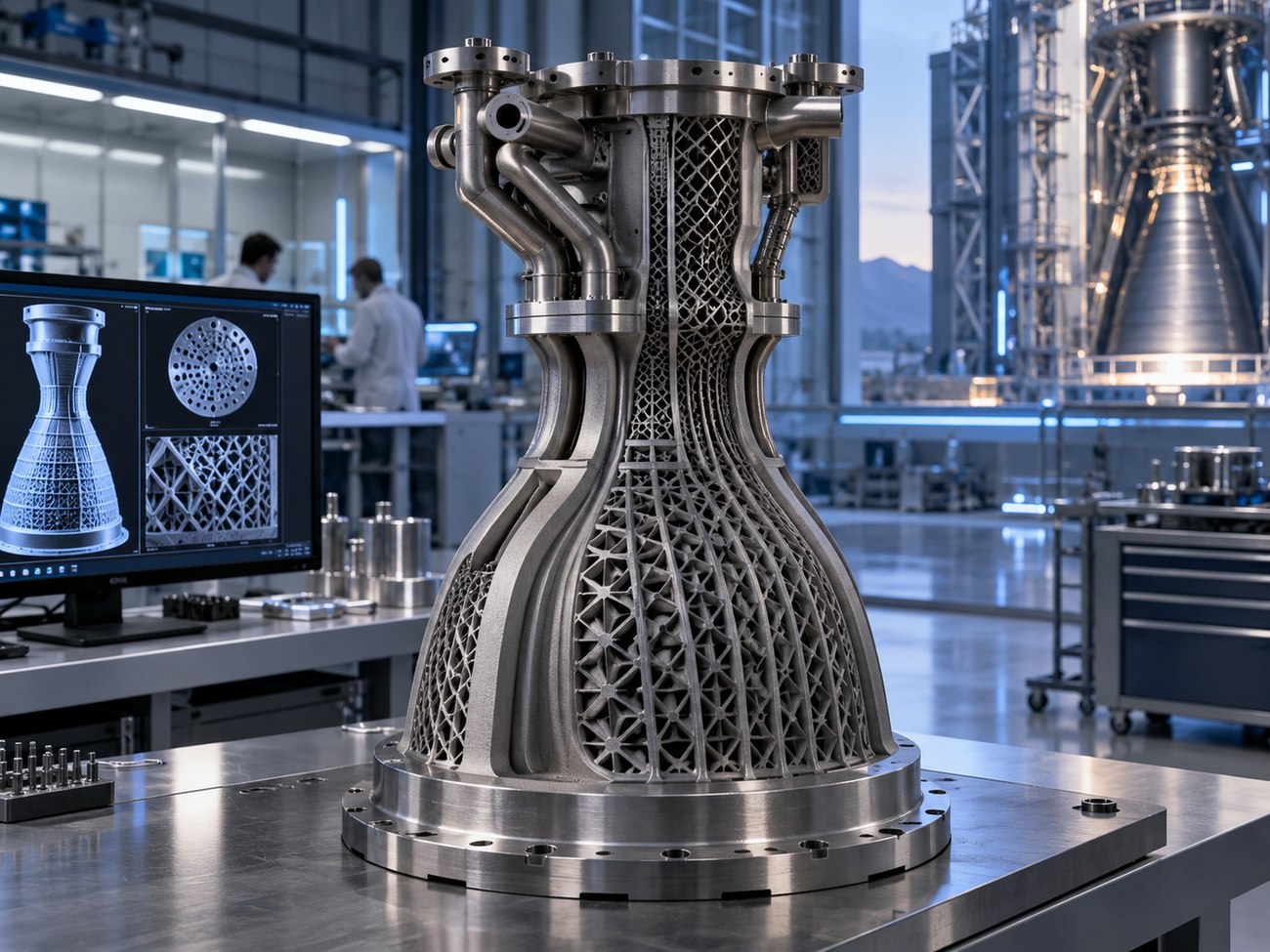
Propulsion: thrust chambers and nozzles
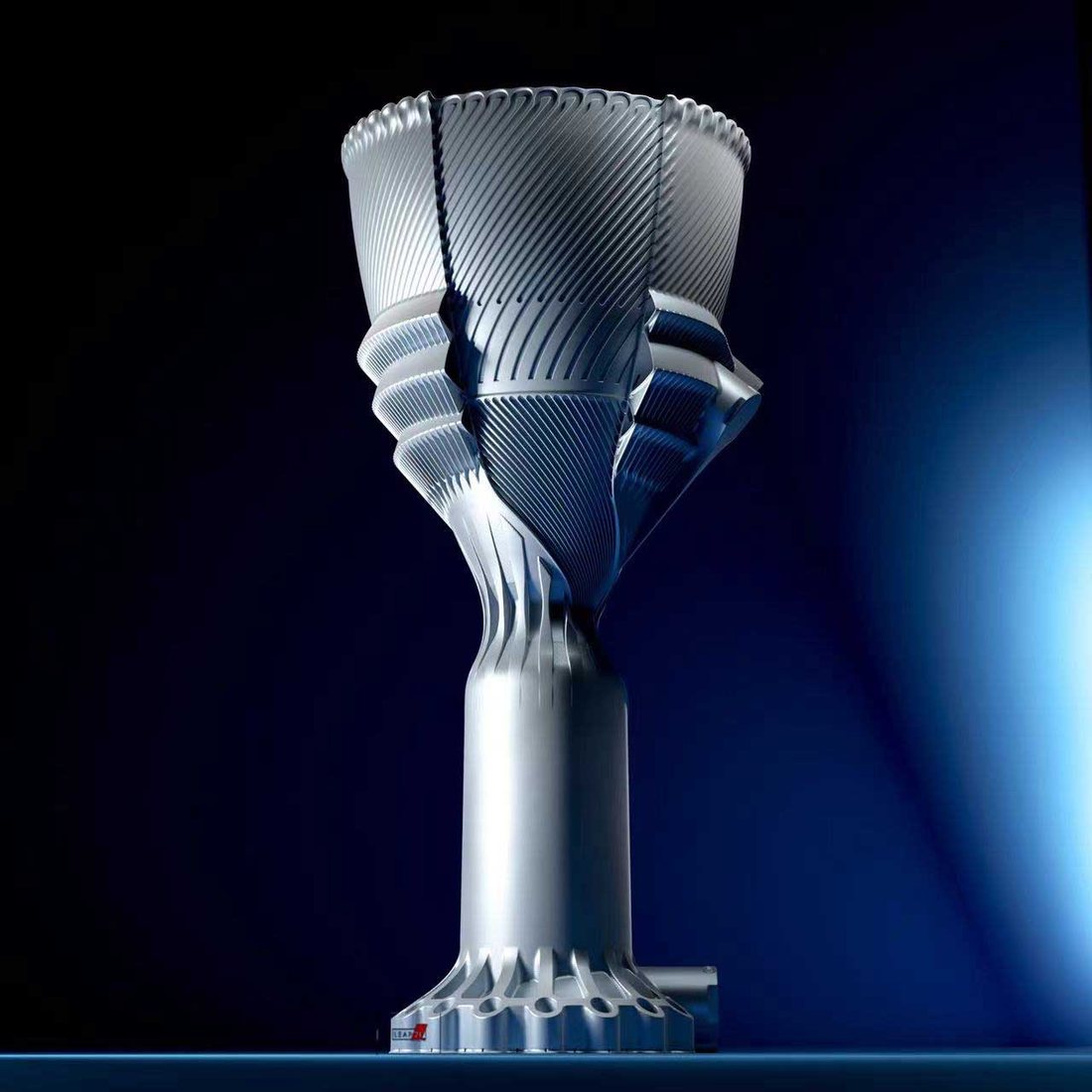
This is the application that forced additive to grow up. A thrust chamber carries regenerative cooling inside the wall: hundreds of channels following the contour, with section varying where the heat flux changes. Conventionally that means formed tubes brazed one by one; in additive it is a single body, and the number of joints — that is, of ways to fail — collapses.
The external lattice is not styling: it carries the chamber at minimum mass while leaving access to the manifolds. Every kilogram that does not launch is payload that launches in its place, which is why in this sector part cost is not the deciding variable.
- Per-batch process qualification
- Witness specimens in the same job
- CT scanning of internal channels
- Powder traceability
- Hot-fire testing on the component
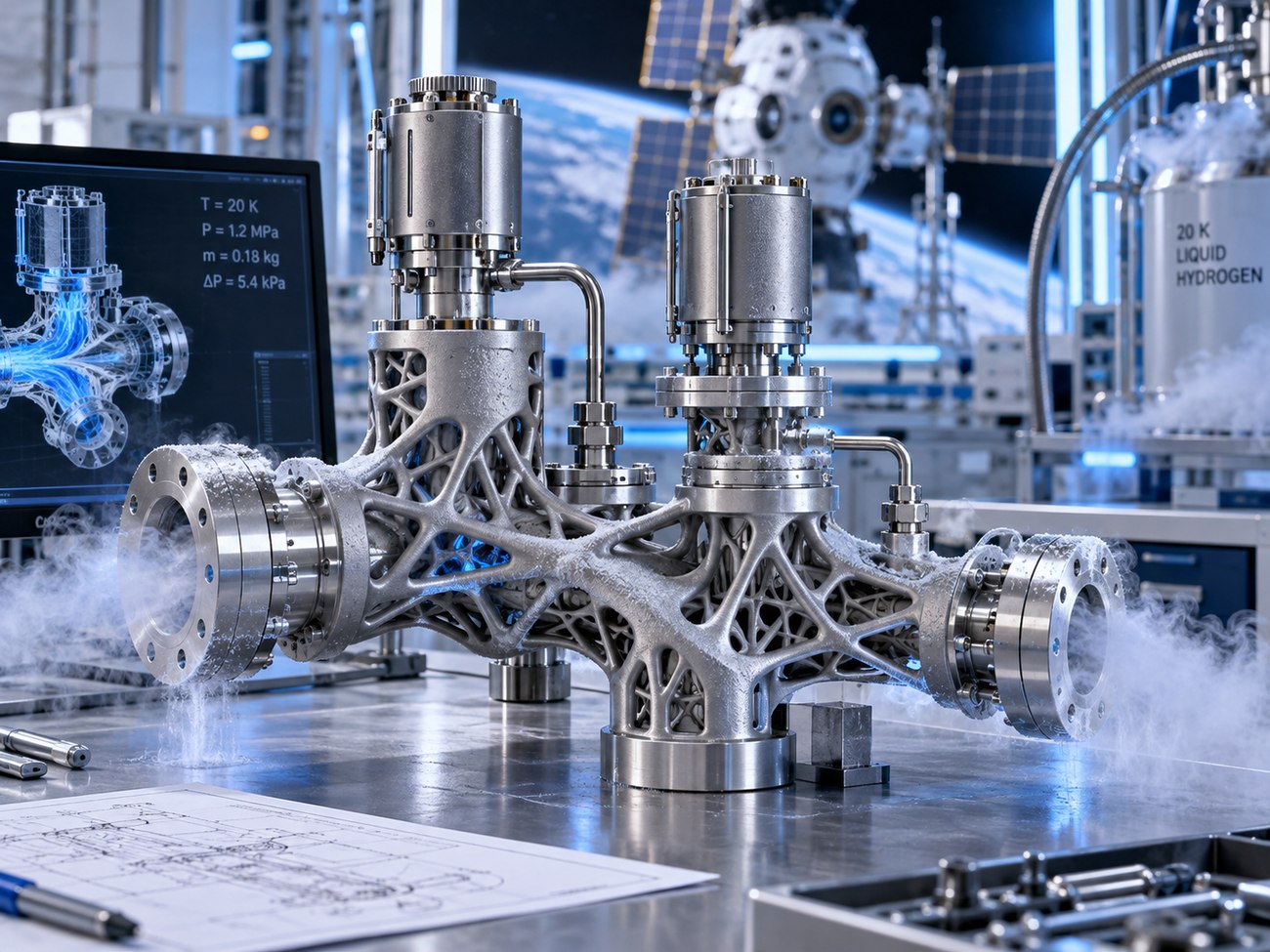
Cryogenic valves and manifolds
At twenty kelvin the rules change. Many materials lose toughness and turn brittle exactly where margin is needed, hydrogen permeates and embrittles susceptible alloys, and every cool-down and warm-up cycle moves the seals. Material selection is made on low-temperature toughness, not on room-temperature strength.
The additive advantage here is twofold: lightening a structure that only has to carry load, and cutting the number of joints in a circuit where every fitting is a potential leak path and a thermal bridge. On an orbiting system both are paid for every day of the mission.
- Low-temperature toughness verified
- Hydrogen compatibility
- Leak testing under thermal cycling
- Non-destructive inspection of walls
- Documented mass budget
Combustors and hot-section components
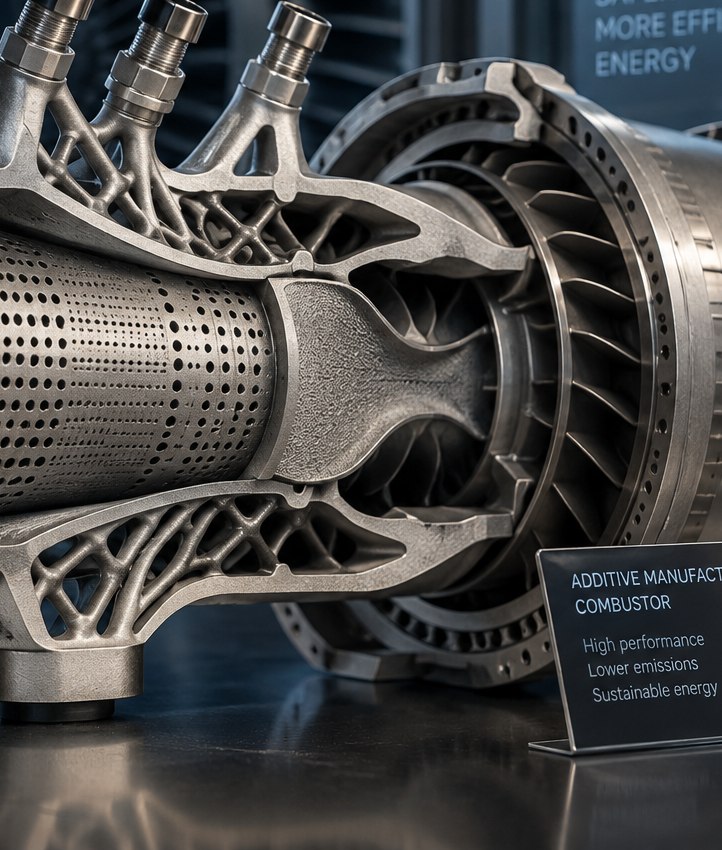
In the combustion section of a turbine the material works close to its limit continuously, not in peaks. The liner carries thousands of film cooling holes that must have the right diameter and angle: producing them in the build, rather than by subsequent drilling, changes production time and allows hole geometries no drill can make.
Around it, the load-bearing structure can be lightened and integrate the fuel manifolds in a single part. Cutting the part count matters as much as performance: in an assembly running continuously, every joint removed is one inspection point fewer for the life of the plant.
- Qualified nickel superalloys
- Heat treatment and HIP
- Cooling hole inspection
- Elevated-temperature mechanical testing
- In-service inspection plan
Flow control in severe service
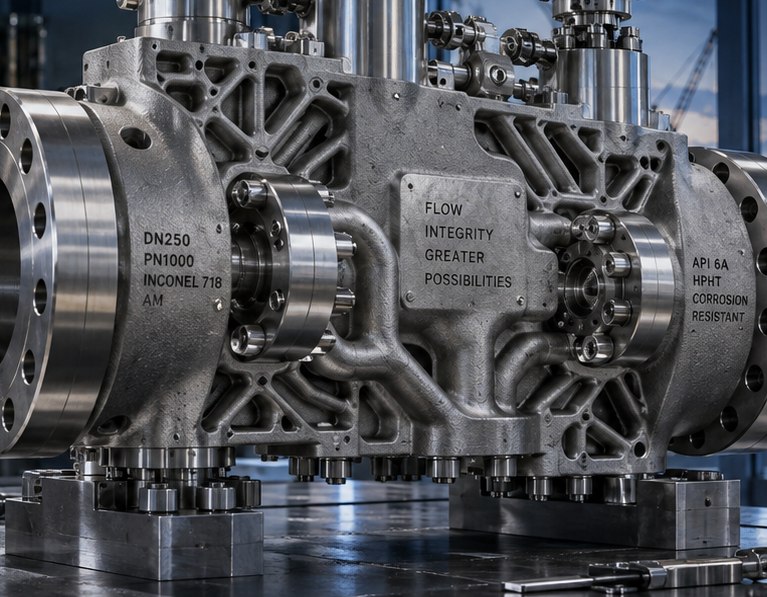
High pressure, corrosive fluids and, often, hydrogen sulphide: this is the environment where material selection is constrained before the design even starts. An additive valve body replaces orthogonal drillings closed with plugs — each a potential leak — with curved, optimised-section ports, and consolidates several bodies into one block.
The weight saving is not vanity: on a platform topside mass is a structural constraint, and every tonne saved is capacity released. But none of it counts without qualification: in this sector sour service conformity and full traceability come before any discussion of geometry.
- Sour service suitability (NACE MR0175 / ISO 15156)
- Material qualification for pressure and temperature
- 100% NDT on critical parts
- Traceability from the powder batch
- Pressure and leak testing
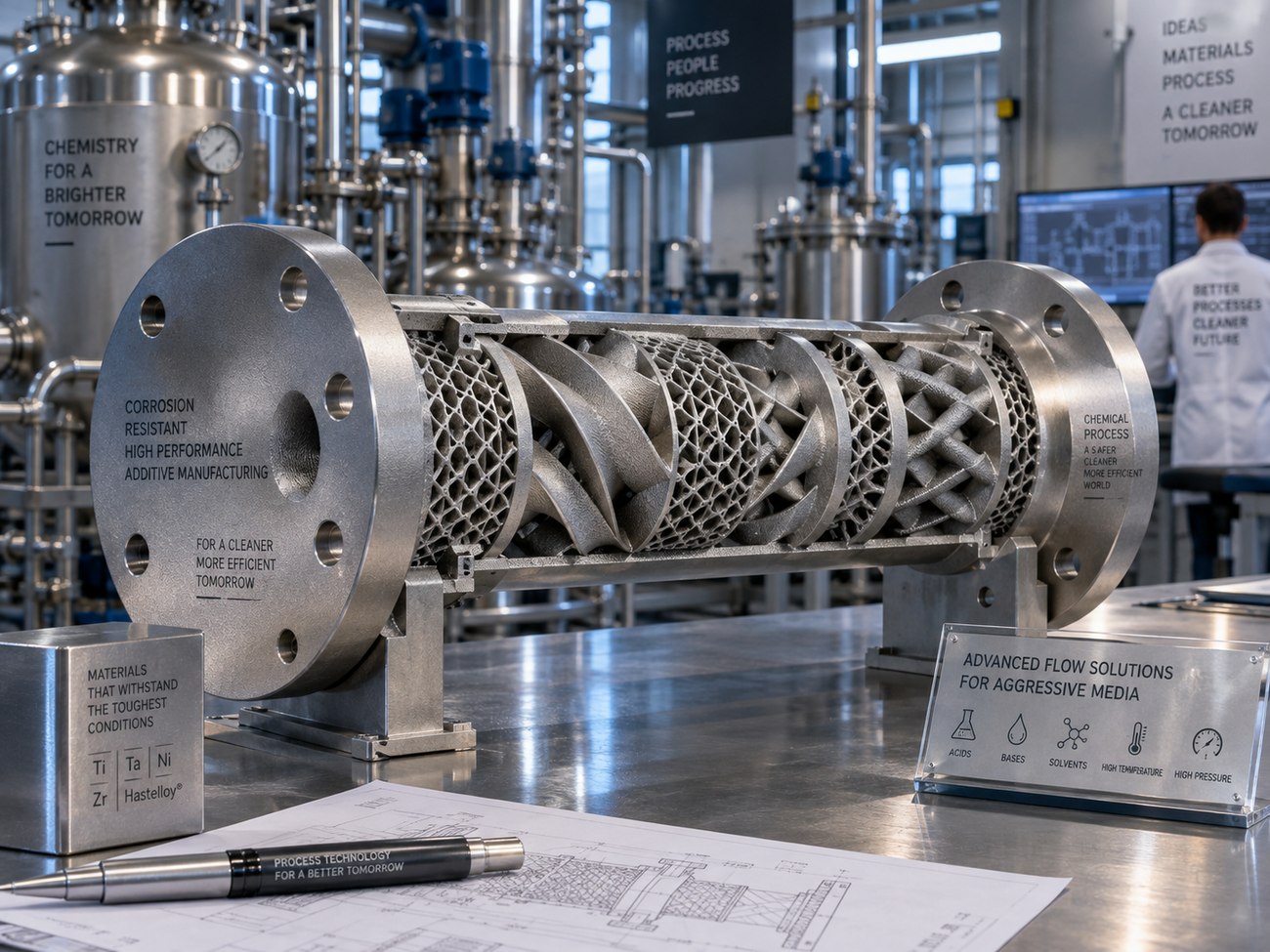
Static mixers and exchangers for aggressive media
In a static mixer the performance is entirely in the internal geometry: the degree of mixing achieved and the pressure drop paid to achieve it. Elements have always been welded or slotted into a tube, and internal welds are exactly where corrosion starts. Building element and body together removes them.
The second advantage is material freedom: the alloys that resist acids, bases and solvents — nickel-chromium-molybdenum, titanium, zirconium, tantalum — are difficult or expensive to machine, and in additive they are used only where genuinely needed, in the thickness strictly required.
- Chemical compatibility verified on the real fluid
- No internal welds
- Pressure testing
- Controlled internal roughness
- PED directive where applicable
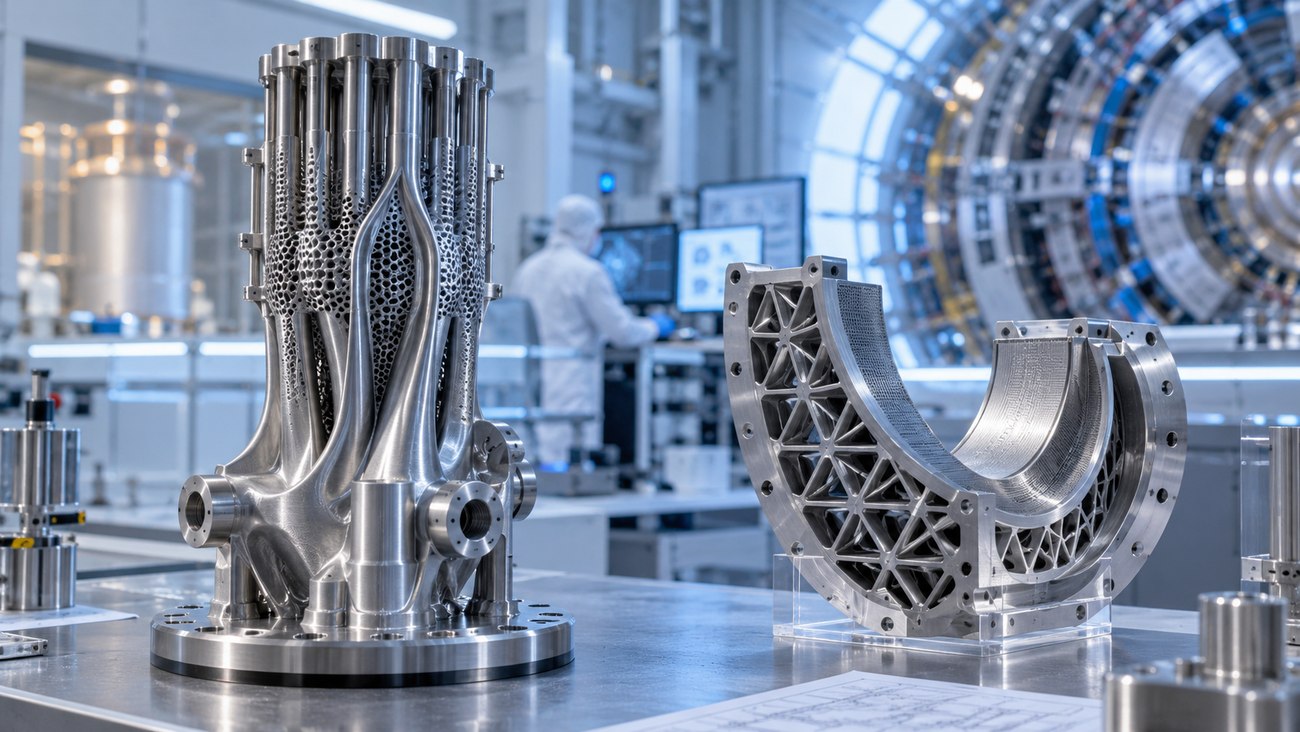
Components for research facilities and reactors
This is the sector with the most extreme ratio between part count and volume of documentation: batches of a few units, unique geometries that will never repeat, and a qualification file that weighs more than the component. Research laboratories were among the first to take metal additive into environments of this kind, precisely because the complex one-off is where the technology has least competition.
Here additive does not compete on cost: it competes on feasibility and time. A free-form component with internal channels and integrated shielding often has no manufacturing alternative — and when it has one, it needs years of tooling that an experimental programme cannot afford.
- Material qualified for the radiation environment
- Full metallographic characterisation
- Extensive non-destructive inspection
- Complete batch traceability
- Design and process documentation
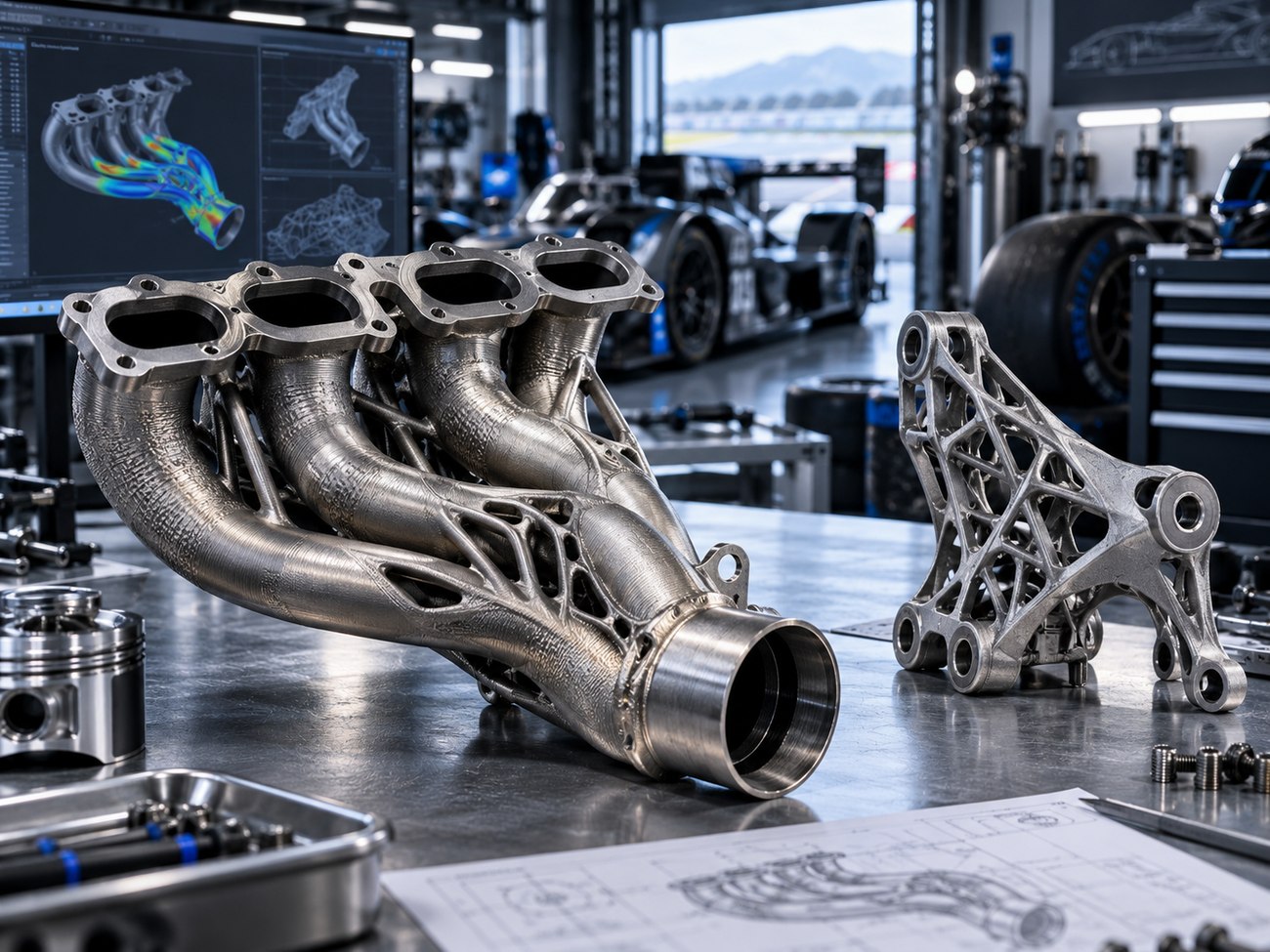
Manifolds and high-performance suspension
In motorsport the constraint is not cost but the calendar: between races there are days, not months. An additive exhaust manifold lets the runners be drawn around the real gas dynamics — equalised lengths, generous radii, thin walls — and tested on the dyno before the tooling for a cast version would even have been ordered.
Uprights and arms redesigned by topology act on unsprung mass, the weight reduction with the most direct effect on grip and dynamic behaviour. It is also the sector that acts as a laboratory: what is tried here reaches series production a few years later, already mature.
- Design iteration in days
- Dyno testing on the real part
- Weight check on every unit
- Fast dimensional verification
- Traceability by season
Where metal has already given up
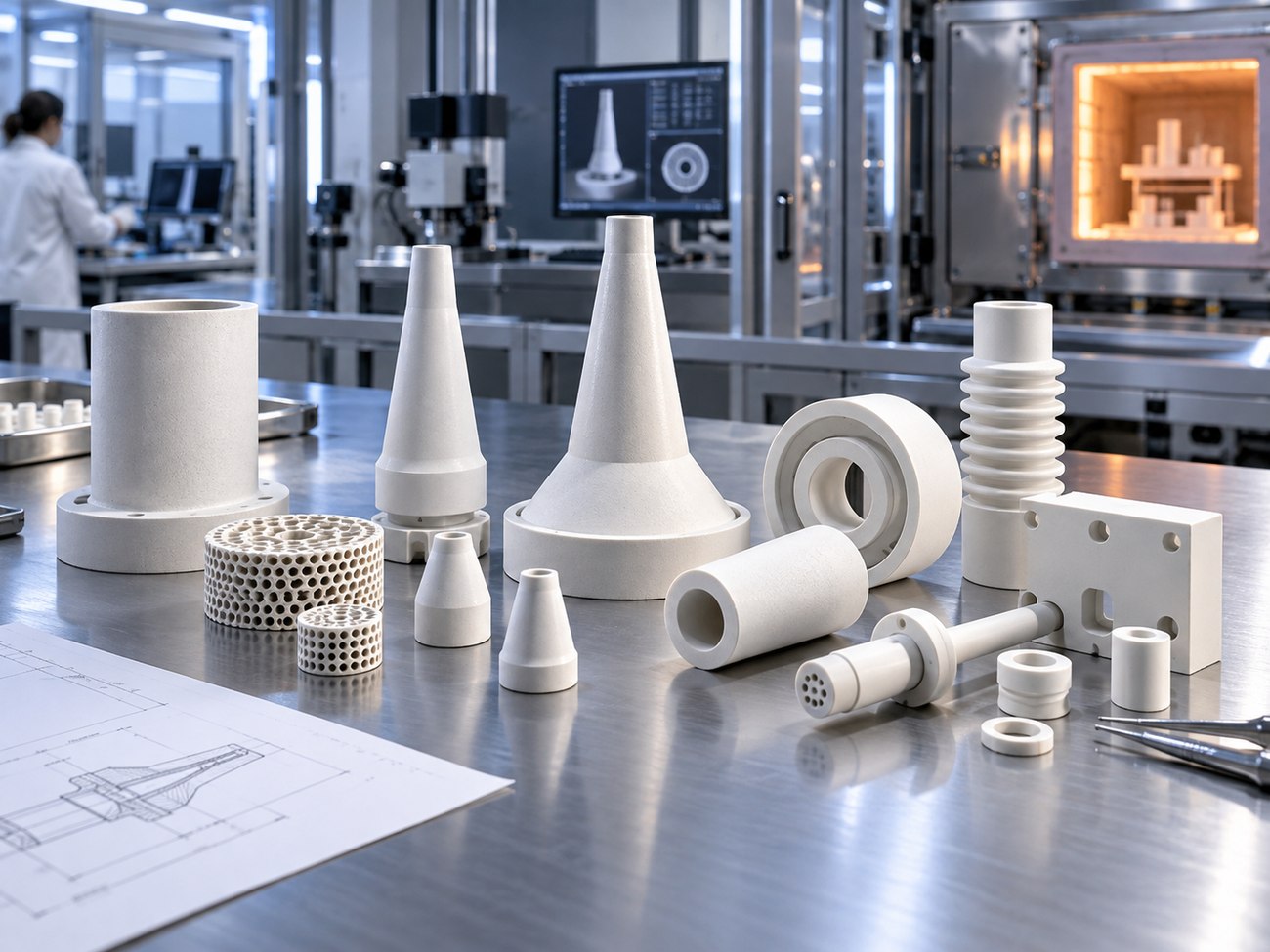
Beyond the limits of superalloys, in severe abrasion, chemical attack or where electrical insulation is needed, the candidate is not another metal: it is a ceramic. Nozzles, insulators, crucibles, wear bushings and porous structures in alumina, zirconia, silicon carbide and nitride work where any alloy would distort or corrode.
What printing adds is the shape. Pressing forces geometries that release from a die; printing does not, and it opens internal channels, designed porosity and irregular cells. The remaining constraint is sintering shrinkage, compensated in the model: tight dimensions come from a final grinding operation.
- Ceramic selected on the degradation mechanism
- Sintering shrinkage compensation
- Grinding of functional dimensions
- Thermal shock testing
- Porosity control
What each environment demands
| Environment | Critical variable | Typical materials | Evidence required |
|---|---|---|---|
| Space propulsion | Heat flux and mass | Inconel 718 · CuCrZr · Ti6Al4V | Internal CT, hot-fire testing |
| Cryogenics | Toughness at 20 K | 316L · Inconel 625 · Al · Ti | Leak testing under thermal cycling |
| Turbomachinery | Continuous temperature | Hastelloy X · IN939 · CM247 | Elevated-temperature testing, HIP |
| Oil & gas | Corrosion and pressure | Inconel 625/718 · duplex | Sour service, 100% NDT |
| Process chemistry | Chemical attack | Hastelloy · Ti · Zr · Ta | Compatibility on the real fluid |
| Nuclear | Irradiation | Stainless · dedicated alloys | Metallography, complete file |
| Motorsport | Time and mass | Ti6Al4V · Inconel · Al-Mg-Sc | Weight and dimensions per unit |
| Technical ceramics | Wear and high temperature | Al₂O₃ · ZrO₂ · SiC · Si₃N₄ | Thermal shock, porosity |
The table is an orientation map, not a specification. Applicable materials and evidence depend on the component, the customer and the governing standards, and must be confirmed case by case before committing.
The questions we are asked most often
What distinguishes a 'high technology' component from a normal one?
Not the complexity of the shape, but the consequences of failure. If a part failing creates a risk to people, to the plant or to a mission, the component enters this class and cost stops being the primary criterion: what comes first is the ability to demonstrate that the part will do what it must, and that the next batch will too. A geometrically trivial fitting in a gas line is high technology; a very complicated bracket on a coffee machine is not.
How much more does a qualified component cost than a normal one?
The difference is rarely in the part: it is in qualification and inspection, which are largely a fixed cost independent of the number of units. On a small batch they can exceed the build cost; over repeated batches they dilute. That is why the right question is not what the part costs, but across how many parts the qualification path is spread.
Can an external supplier be qualified instead of building the capability in-house?
In the large majority of cases that is the correct choice, and for anyone who does not do additive for a living it is almost always the only sensible one. Qualifying a supplier concerns their process, not their machine: you verify the qualification protocol, powder management, inspection plan, traceability and the ability to requalify when something changes. It is documentation and audit work, and exactly the kind of activity we support companies on.
What happens if the supplier changes machine or powder batch?
A requalification is needed, and it is the point contracts most often get wrong. Parameters are not transferable between different machines, nor between two machines of the same model without verification. In regulated sectors the supplier is obliged to notify the change; in unregulated ones it has to be written into the contract, because otherwise you find out from a difference in test results.
Where do you start if the component is critical but we have no additive experience?
Not with that component. You start with a part from the same environment but without safety consequences — a fixture, a non-critical spare, a functional prototype — to build design experience and the supplier relationship. The critical component comes later, when the supply chain has already been tested on something that, if it goes wrong, only costs time.
Do you have a component that cannot fail?
Tell us the environment it works in and the evidence your customer requires: we assess feasibility, material and the qualification path, and tell you plainly whether the route is viable.
Let us look at your component →